
Level I
- Weight
- 2
- Odds at activation
- 45 in 100
- Receives
- 1.0 × a Level One

On the five levels of member bank vault, the weight each carries, and the arithmetic by which every distribution is divided among them.
To the Governors, the eligible, and whoever else is reading this.
Section X of Purposes and Functions stated that the full schedule of the five kinds of bank would be announced at a later date. This is that date.
The schedule below is complete. It states how many levels there are, the odds at which each is assigned, the weight each level carries, and the exact arithmetic by which every distribution is divided among them. Where the Bank has not yet decided something, that is stated too, in a section of its own, so that the reader is not required to guess and is not invited to assume.
The Bank has published its most unusual mechanics ahead of its most flattering ones. That is the Bank's practice and the reader who has followed the Bank for any length of time did not need to be told this.
There are five levels of member bank vault. Level One is the smallest. Level Five is the largest. Every chartered vault is one of them and no vault is anything else.
The plates below are the five levels. They are printed at a common size. The Bank does not use photographs to make a comparison of size. That comparison is made in Section III, as a figure, where it can be checked.
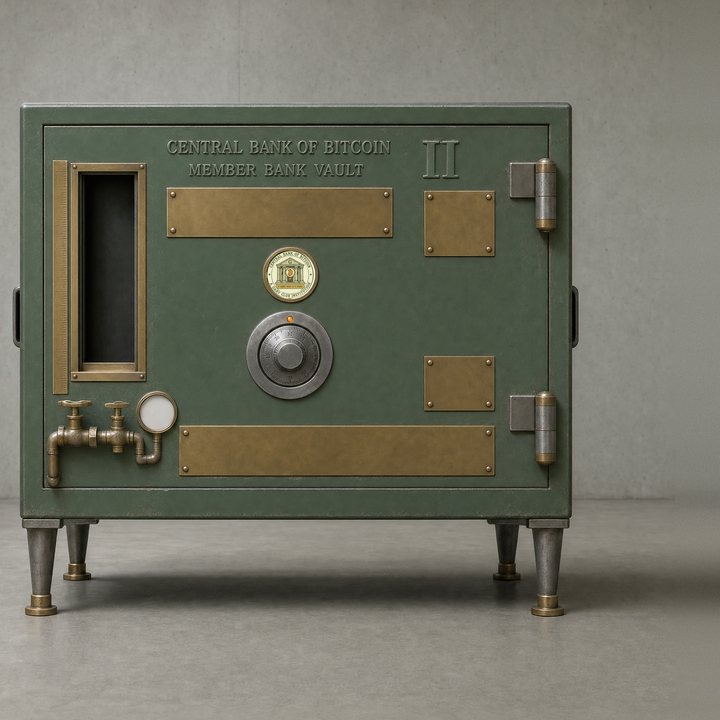

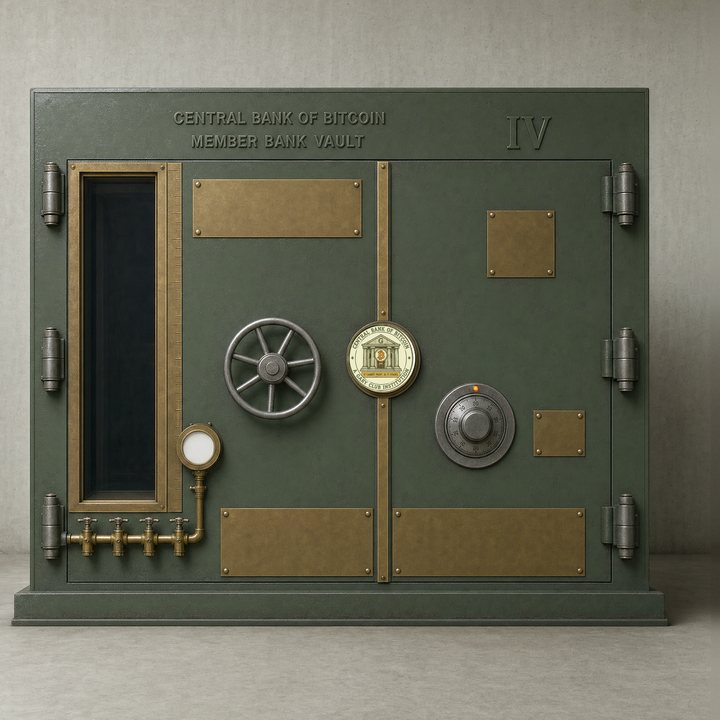
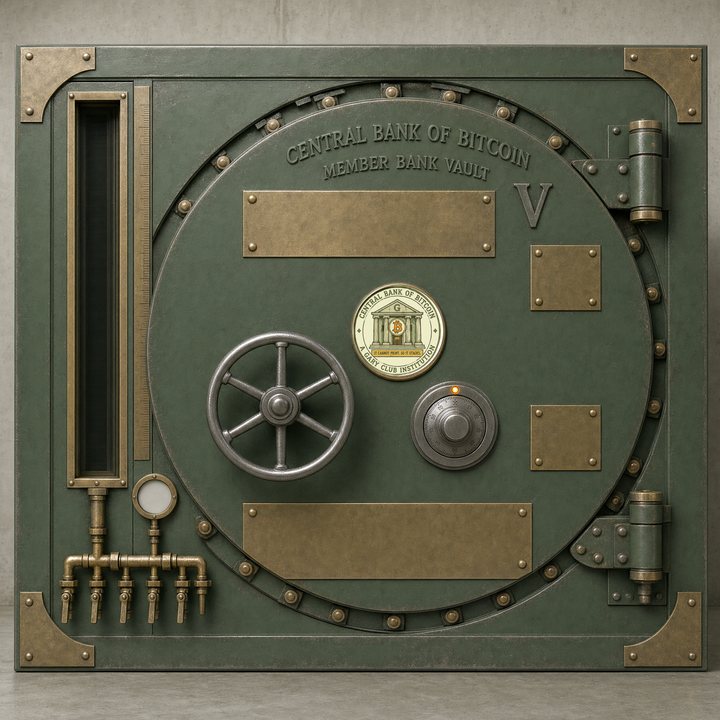
A vault's level is assigned at activation.
It is assigned by fate. It cannot be applied for and it cannot be appealed. The member does not choose it. The Bank does not choose it. The parent organization does not choose it. Nobody chooses. That is what makes it fate, and fate, the reader will recall, is permanent.
| Level | Odds at activation | Expected at 2,100 vaults |
|---|---|---|
| Level I | 45 in 100 | 945 |
| Level II | 25 in 100 | 525 |
| Level III | 15 in 100 | 315 |
| Level IV | 10 in 100 | 210 |
| Level V | 5 in 100 | 105 |
| Total | 100 in 100 | 2,100 |
The Bank does not consider this arbitrary. The Bank considers it impartial.
Fate is documented and fate is executed on chain. The reader will be able to verify that no thumb was on the scale, because the scale does not have room for thumbs.
Every level carries a weight. Weight is the only quantity that decides how a distribution is divided, and the ladder is short on purpose.
The average vault carries a weight of 3.05. That figure is the same whether 240 vaults are activated or 2,100, because it is decided by the odds and the weights and by nothing else.
The Bank generates revenue. Every revenue event is divided as set out in Section VI of Purposes and Functions: eighty-five percent to the vaults, fifteen percent retained by the Bank. The division is permanent.
The eighty-five is divided among activated vaults, by weight.
The sum on the bottom line is the denominator. The Bank publishes it at every settlement, with the count at each level, so that any member may do the division themselves and arrive at the figure the Bank arrived at. Section VI.
Three consequences follow. The Bank states them rather than leaving them to be discovered.
The Bank prefers arithmetic to assurance. What follows is this schedule applied to three censuses at a distribution of one thousand dollars. The figure is chosen because it is round and it means nothing else. Every column below can be reproduced by the reader from the weights in Section III and the counts shown.
| Level | Vaults | Weight each | Weight total | Each vault receives | The level takes |
|---|---|---|---|---|---|
| Level I | 108 | 2 | 216 | $2.73 | 29.5% |
| Level II | 60 | 3 | 180 | $4.10 | 24.6% |
| Level III | 36 | 4 | 144 | $5.46 | 19.7% |
| Level IV | 24 | 5 | 120 | $6.83 | 16.4% |
| Level V | 12 | 6 | 72 | $8.20 | 9.8% |
| Total | 240 | 732 | $1,000.00 | 100.0% |
| Level | Vaults | Weight each | Weight total | Each vault receives | The level takes |
|---|---|---|---|---|---|
| Level I | 945 | 2 | 1,890 | $0.31 | 29.5% |
| Level II | 525 | 3 | 1,575 | $0.47 | 24.6% |
| Level III | 315 | 4 | 1,260 | $0.62 | 19.7% |
| Level IV | 210 | 5 | 1,050 | $0.78 | 16.4% |
| Level V | 105 | 6 | 630 | $0.94 | 9.8% |
| Total | 2,100 | 6,405 | $1,000.00 | 100.0% |
A charter that is not activated is not in the denominator. The effect is not decorative. Of the 240 founding charters, suppose 20 are activated and the rest are held. The same $1,000.00 then divides as follows: a Level One vault receives $32.79 in place of $2.73, which is 12 times as much, and a Level Five receives $98.36 in place of $8.20. Nothing about the schedule changed. Only the denominator did.
At every settlement the Bank publishes the count of activated vaults at each level and the sum of their weights. That sum is the denominator. It is published so that any member may do the division themselves and arrive at the figure the Bank arrived at.
The census stands as follows.
| Level | Activated | Weight each | Weight total | Each vault receives, per $1,000.00 |
|---|---|---|---|---|
| Level I | 0 | 2 | 0 | none |
| Level II | 0 | 3 | 0 | none |
| Level III | 0 | 4 | 0 | none |
| Level IV | 0 | 5 | 0 | none |
| Level V | 0 | 6 | 0 | none |
| Denominator | 0 | 0 |
No vault has been activated. The denominator is zero. No distribution has been made.
A vault's level may be raised. It is raised one step at a time. Level One may become Level Two and Level Two may become Level Three. No step may be skipped.
A level is raised by burning $CBOB, the internal unit described in Section VII of Purposes and Functions. $CBOB is obtained from the Bank. It is not obtained anywhere else.
A raised level is permanent. A level never falls.
The weights in this schedule are the standard weights. They are what a vault carries if nothing is done to it. Raising a level moves a vault up the same ladder every other vault stands on. It changes nothing in Section IV.
| Step | Weight | Each vault receives, per $1,000.00 | Increase |
|---|---|---|---|
| I to II | 2 to 3 | $0.31 to $0.47 | 50.0% |
| II to III | 3 to 4 | $0.47 to $0.62 | 33.3% |
| III to IV | 4 to 5 | $0.62 to $0.78 | 25.0% |
| IV to V | 5 to 6 | $0.78 to $0.94 | 20.0% |
The Bank has not announced what raising a level costs, or the date on which raising opens. Section VIII.
A schedule is only useful if the reader can tell where it stops. The following are not settled. The Bank declines to imply otherwise, and the reader should treat any figure circulating on these four points as somebody's guess.
The Bank will publish each of these in its own order, as it has published everything else.